Meet D-rex: The Giant Fungus From Yunnan With Roots in the Dinosaur Extinction
In this post
Scientists exploring the forests of Yunnan in southwestern China found pale, finger-like growths pushing up from the roots of trees. They turned out to be a giant fungus no one had ever named. Now it has a name worthy of its size: Dianjunus rex, nicknamed "D-rex". The Dianjunus rex fungus stands up to 50 cm tall, weighs up to 2.2 kg, and belongs to a lineage that appears to date back to the age of the dinosaurs' extinction.
The discovery was published in Frontiers in Fungal Biology and drew worldwide attention in mid-October 2026.
How big is D-rex?
| Measure | D-rex |
|---|---|
| Maximum height | about 50 cm (20 in), including a buried stalk |
| Visible spore-making part | usually 10–20 cm |
| Typical weight | 250–600 g |
| Heaviest specimen | 2.2 kg (about 4.9 lb) |
| Previous height record in its group | about 20–30 cm |
That makes it the largest known fruiting structure in the Ascomycota, the biggest group of fungi with more than 64,000 known species.
Not your typical mushroom
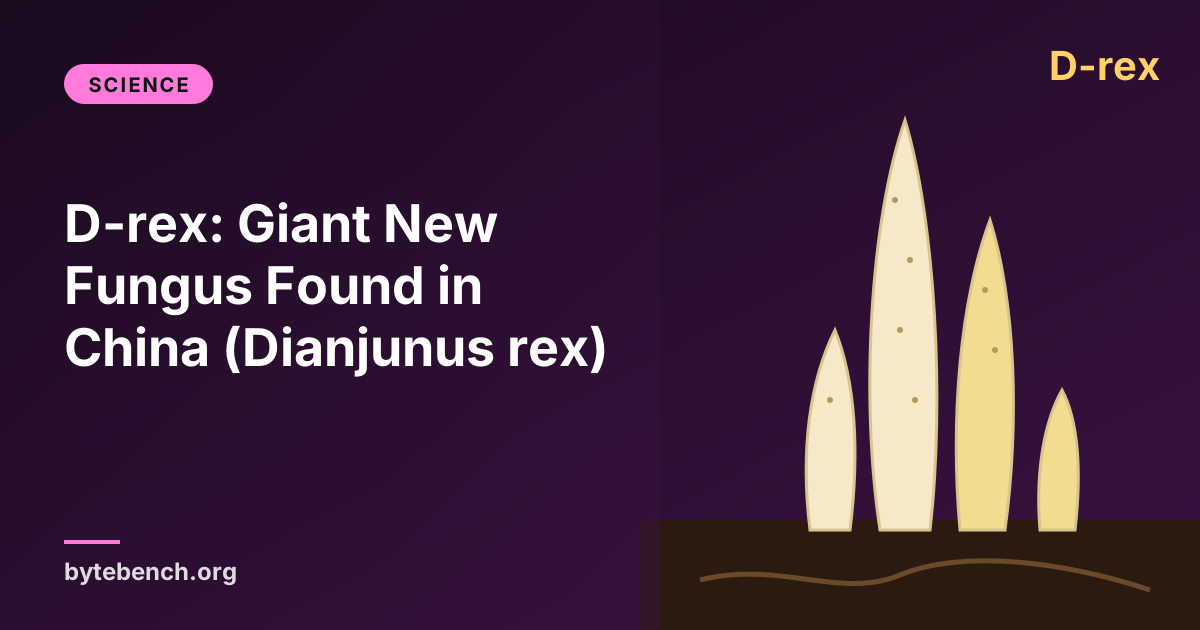
Ascomycetes don't usually make the classic cap-and-stem mushrooms you see in shops. Many produce small cups, crusts or clubs. D-rex grows a tall, fleshy, upright structure called a stroma, which releases spores through tiny openings. Its surface shifts from white to yellow as it matures.
Researchers found specimens attached to the roots of host trees, including a Chinese cork oak, in temperate coniferous forests and a tropical rainforest in Yunnan.
A brand-new branch of the fungal family tree
D-rex isn't just a new species. DNA analysis comparing it with about 200 related species, plus complete genomes of three specimens, showed it needs:
- a new genus, Dianjunus
- and an entirely new family, Dianjunaceae, within the order Xylariales
The name nods to Dian, an ancient kingdom in Yunnan, and "jūn", the Chinese word for fungus. "Rex" is for its regal size.
A lineage born as the dinosaurs died
Genetic dating suggests the D-rex family split off around 65 million years ago, close to the asteroid impact that wiped out non-bird dinosaurs. The researchers suggest the upheaval, with forests collapsing and dead wood everywhere, may have opened new opportunities for wood-associated fungi. That link is a hypothesis, not proven.
Why does it grow so tall? One idea is that height helps release spores into air currents above the forest floor.
Why this discovery matters
Scientists have described about 150,000 fungus species, but estimates suggest millions exist. Corresponding author Indunil Senanayake of the Kunming Institute of Botany says D-rex shows how much fungal diversity remains hidden in East Asian forests. Fungi recycle nutrients, partner with tree roots and produce medicines, so every new lineage could matter.
Can you eat D-rex?
Yunnan is famous for wild mushroom cuisine, so people naturally asked. There is no evidence it is safe to eat. Never eat wild fungi unless an expert has identified them.
Sources
Frequently asked questions
What is Dianjunus rex?
A newly described giant fungus from Yunnan, China, nicknamed D-rex, representing a new species, genus and family.
How big does D-rex grow?
Up to about 50 cm tall and 2.2 kg, though most specimens weigh 250–600 g.
Is D-rex the largest fungus in the world?
No. Some underground fungal networks are far bigger. D-rex has the largest known fruiting structure among ascomycete fungi.
How old is the D-rex lineage?
DNA evidence suggests about 65 million years, near the time of the dinosaur extinction.
Where was D-rex found?
In temperate coniferous forests and tropical rainforest in Yunnan Province, China.