MIT's Paper-Thin Robot Swims on Living Muscle and Follows the Light
In this post
Most robots run on motors and batteries. A new one from MIT runs on living muscle. Engineers in Ritu Raman's lab have built a paper-thin biohybrid robot, a machine that combines living tissue with engineered parts, that swims through water and steers through a simple maze whenever researchers shine light on its fins.
The work, published in Advanced Functional Materials and widely covered in October 2026, is the first example of a very thin, two-dimensional robot that moves itself using muscle.
What the robot looks like
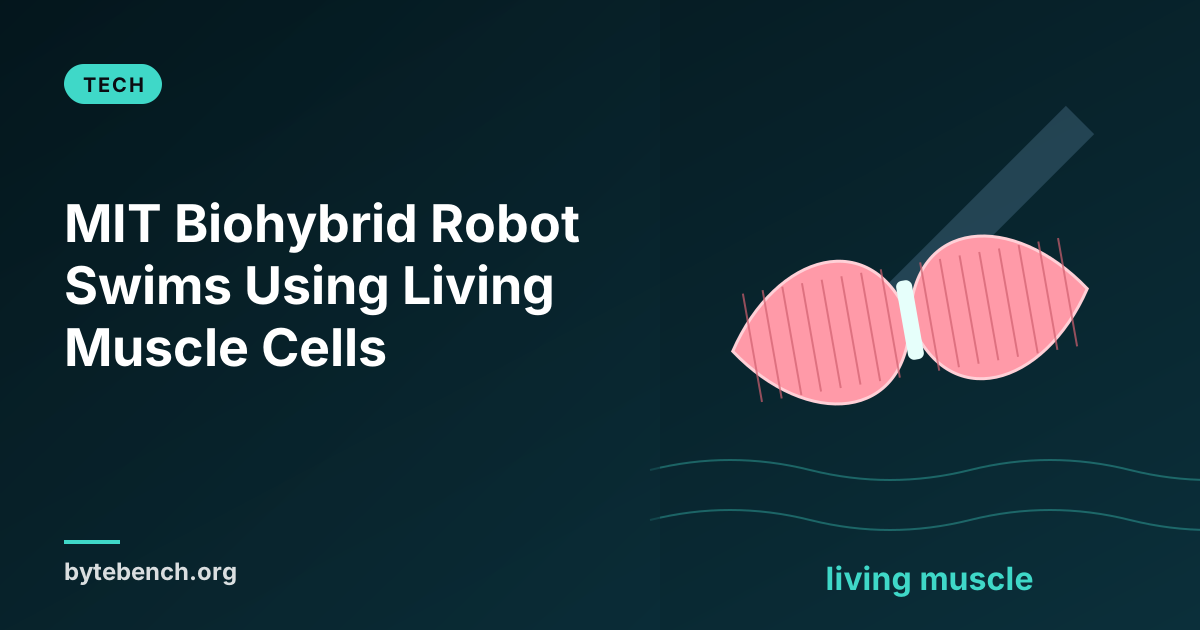
Picture a flexible strip of gel about the size of a stick of chewing gum, split into two fins. Each fin is coated with a single layer of skeletal muscle cells, thinner than a strand of human hair. There is no motor, no gears and no on-board battery.
The gel skeleton is made from a material called GelMA, about half a millimeter thick. The muscle cells come from mice and are genetically engineered to contract when hit by light.
How light makes it swim
Shine light on one fin and its muscle twitches, flapping the fin and pulling the robot forward. Light both fins and both flap. By switching the light on and off at different intervals, and choosing which fin to illuminate, the team controls both speed and direction.
Raman compares it to having two independent muscles. In tests, researchers moved a light over a water-filled dish and the robot followed it, flapping its way through a small maze.
This light-switch trick is closely related to optogenetics, the technique that won the 2026 Nobel Prize in Physiology or Medicine.
Three engineering tricks that made it work
Thin muscle layers usually produce too little force to move anything through water, which is much harder to push through than air. The team solved this with:
- Square grooves. Stamping square-bottomed channels into the gel lined the cells up neatly. Aligned cells fuse into stronger, coordinated fibers.
- The right stiffness. Cells grew better and pulled harder on stiffer gel, while a half-millimeter film stayed light enough that the muscle didn't peel off when it contracted.
- Exercise. Before assembly, the muscle was trained with repeated light pulses to make it stronger, a workout routine for cells.
How it compares to other living robots
Biohybrid swimmers aren't brand new. A robotic ray driven by rat heart cells swam in 2016, and a fish robot using human heart cells swam on its own in 2022. Another 2026 design, OstraBot, uses trained skeletal muscle and moves about four times faster than MIT's swimmer.
MIT's contribution is the thinness. Earlier designs relied on bulky 3D chunks of muscle requiring millions of cells. A single layer uses far less biological material, which could make biohybrid robots cheaper and smaller.
What could living robots do?
Living tissue is soft, sensitive to its surroundings and can heal itself. Raman's team imagines biohybrid machines exploring places too fragile or unpredictable for metal robots, such as delicate reefs or the inside of the body. Even at slow speeds, a muscle-powered swimmer could monitor water conditions. The next goal is a better body shape for faster swimming.
Sources
Frequently asked questions
What is a biohybrid robot?
A robot that combines living cells or tissue with engineered materials, using the tissue for movement or sensing.
How does the MIT robot move?
Light-sensitive muscle cells on its two gel fins contract when illuminated, flapping the fins to swim.
How big is the robot?
About the size of a stick of chewing gum, with a gel skeleton about half a millimeter thick.
Who led the research?
Ritu Raman, associate professor of mechanical engineering at MIT, with first author Maheera Bawa.
Is it fast?
No. It is slow, and other biohybrid swimmers are quicker, but its ultra-thin design is new.