Nobel Prize in Physics 2026: The Ghost Particles Caught in Antarctic Ice
In this post
The 2026 Nobel Prize in Physics went to a man who helped turn a cubic kilometer of Antarctic ice into a telescope. On 6 October 2026, the Royal Swedish Academy of Sciences awarded the full prize to Belgian-American physicist Francis Halzen for decisive contributions to the IceCube Neutrino Observatory and the discovery of high-energy neutrinos of astrophysical origin. The IceCube neutrinos Nobel is also unusual for another reason: it was not shared, which has become rare in physics.
What is a neutrino?
Neutrinos are tiny particles with no electric charge and almost no mass. They are everywhere. Trillions from the Sun pass through your body every second, and you never notice, because neutrinos almost never interact with anything. Many could pass through a light-year of lead without stopping.
That earned them the nickname "ghost particles", and it also makes them perfect cosmic messengers. Light can be blocked by dust or bent by magnetic fields. Neutrinos fly straight from their source, carrying information from places nothing else can escape.
Building a telescope out of ice
To catch something that almost never interacts, you need an enormous, clear, dark detector. Halzen championed a bold answer: the ice sheet under the South Pole.
IceCube, run from the University of Wisconsin–Madison where Halzen is a professor and principal investigator, works like this:
- Engineers drilled holes with hot water deep into the ice.
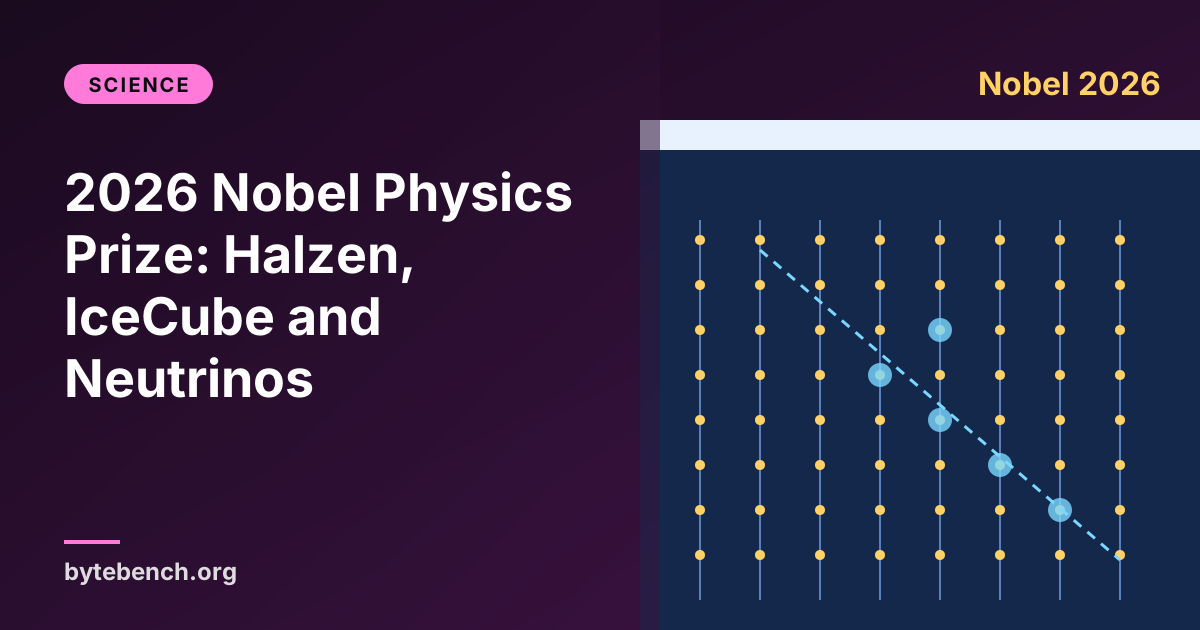
- They lowered strings carrying more than 5,000 light sensors to depths of roughly 1.5 to 2.5 km.
- The sensors fill about a cubic kilometer of ice, which is extremely clear at that depth.
- When a rare neutrino hits an atom in the ice, it creates a charged particle that gives off a faint blue flash. The sensors record the flash and reconstruct the neutrino's direction and energy.
The detector was completed in 2010 and has been watching ever since.
What IceCube discovered
- 2013: The first clear evidence of high-energy neutrinos coming from beyond our Solar System, opening the field of neutrino astronomy.
- 2018: A neutrino traced to a blazar, a galaxy with a supermassive black hole firing a jet toward Earth, the first time a cosmic neutrino source was identified.
- 2022: Neutrinos linked to the active galaxy NGC 1068.
- 2023: The first picture of our own Milky Way made with neutrinos instead of light.
These results help solve a century-old mystery: what cosmic engines accelerate particles to energies far beyond anything human-made machines can reach.
Why this Nobel matters
For most of history, astronomy relied on light. Over the past decade, scientists added gravitational waves and high-energy neutrinos, creating what is called multi-messenger astronomy. Halzen's prize recognizes that neutrinos are now a real window on the universe, not just a lab curiosity.
The other 2026 science Nobels
The Physiology or Medicine prize went to optogenetics, a way to switch brain cells on with light. The Chemistry prize went to Henri B. Kagan and Kenso Soai for discoveries concerning nonlinear effects and autocatalysis in asymmetric organic synthesis.
Sources
Frequently asked questions
Who won the 2026 Nobel Prize in Physics?
Francis Halzen, for decisive contributions to the IceCube Neutrino Observatory and the discovery of high-energy astrophysical neutrinos.
What is IceCube?
A neutrino detector made of thousands of light sensors buried in about a cubic kilometer of ice at the South Pole.
Why are neutrinos called ghost particles?
They have no charge and almost no mass, so they pass through matter almost without interacting.
Was the 2026 physics prize shared?
No. Halzen received the full prize alone.
What did IceCube find?
The first high-energy neutrinos from outside the Solar System and some of their sources, including a blazar and the galaxy NGC 1068.